Keflavík Air Base
Operation NapoleonKeflavík Air Base is the military installation beside Keflavík Airport on the wind-scoured Reykjanes Peninsula. Once a strategic link in Western defenses during the Cold War, it becomes the covert staging point for the American operation on Vatnajökull in January 2000. Its setting and infrastructure do more than accommodate the troops: the guarded perimeter, runway, hangars, and nearby shore determine how military secrecy is maintained—and how Kristín and Steve find a way out.
Setting and strategic history
The base stands on Midnesheidi, amid the lava fields roughly an hour’s drive southwest of Reykjavík. The landscape is exposed to constant gale-force winds and has little vegetation; the novel presents it as bleak and barely fit for habitation. Hangars, barracks, shops, a cinema, and administration buildings punctuate the otherwise barren terrain. Runway seven is reserved for the exclusive use of the NATO installation, separating its military activity from the adjoining civilian airport.
The installation’s importance rests on Iceland’s position in the North Atlantic. At the height of the Cold War, Keflavík provided a vantage point for monitoring Soviet submarines, shipping, and aircraft in the Arctic region. The base had been established after the Second World War. Britain occupied Iceland at the beginning of the war, then handed responsibility for the country’s defense to the United States in 1941. The American headquarters was initially in Reykjavík, and the occupying force later included the 5th Infantry Division under Major General Cortlandt Parker. The American presence eventually peaked at about 38,000 troops.
That military role was politically contentious from the outset. The 1949 defense treaty prompted a riot outside Iceland’s parliament, and left-wing parties continued to oppose the base. By 2000, its activities had been greatly curtailed from their Cold War height, but the installation remained a source of friction over Icelandic sovereignty and the reach of American military authority.
The base and the civilian airport
The military zone was already difficult for civilians to access. After Iceland took over the international airport in the 1980s and built its own civil aviation terminal, access to the military area became still more restricted. The military zone was enclosed by a high fence with only two gates, both guarded at all times. Military police patrolled the residential area, even though the fence itself was not continuously manned.
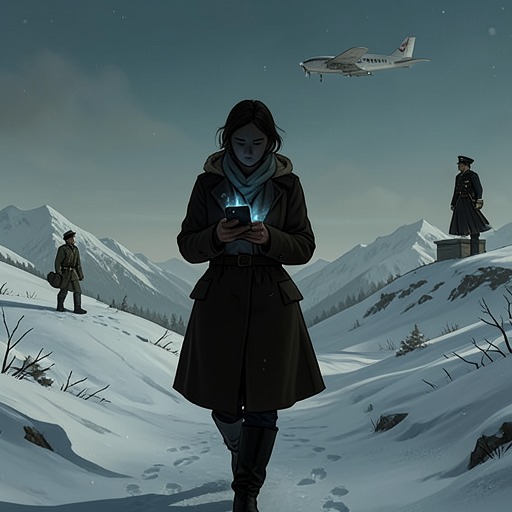
The boundary is not merely a line on a map in Kristín’s story. On the night of 29 January, she directs a taxi to a new housing estate beside the perimeter, waits for it to leave, and runs toward the fence. She eases herself over its barbed wire, which tears her clothes and scratches her hands, then drops about three metres onto soft snow. Her ankle hurts, but she gets up and continues, limping. The fence makes entry dangerous, yet the snow cushions the fall; the physical design of the base turns a desperate crossing into a specific, costly passage rather than an impassable barrier.
Inside the base, the military accommodation reflects the same exposed conditions. Kristín reaches a three-storey block containing twelve apartments, built by Icelandic contractors like a massive bunker. Its thick concrete walls were designed to withstand major earthquakes and the severe Icelandic climate, while the windows are small and heavily glazed. The base’s architecture thus carries both practical protection and an impression of enclosure.
A covert staging point
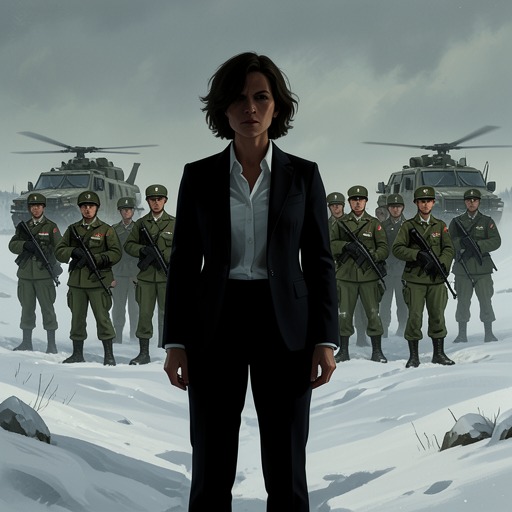
On the evening of 28 January 2000, a C-17 transport plane landed at Keflavík Airport at about eight o’clock local time. It taxied to the end of runway seven, where personnel unloaded snowmobiles, tracked vehicles, skis, and other equipment for the glacier. Within fifteen minutes, the first transporter was on its way south toward Vatnajökull.
The operation’s movement between the military installation and Iceland’s public roads depends on concealment rather than spectacle. Four trucks of different models collected the equipment. One was an unmarked German Mercedes-Benz with ordinary Icelandic licence plates; the trucks left at half-hour intervals and blended into civilian traffic. The base therefore functions as a secure arrival point, but the onward journey is deliberately made to look routine.
Later, Steve reports that a friend at the base, Eastman, has described the troop movements as mysterious. Special forces arrived aboard a C-17 now standing by on a runway, guarded separately, and no one is allowed near it. Even personnel connected with the hangars do not know where the troops have gone. The discrepancy between the visible presence of a large transport plane and the secrecy surrounding its passengers makes Keflavík the operation’s logistical heart and one of its vulnerabilities: information circulates, though incompletely, among people working there.
Escape routes and growing exposure
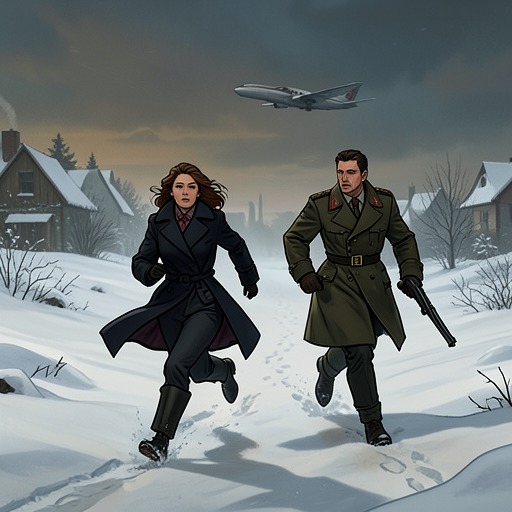
The base’s military precautions intensify as Kristín and Steve prepare to leave. By 30 January, police roadblocks have appeared around the installation, soldiers patrol the Keflavík side of the perimeter, and military traffic has increased. Arnold has given Steve directions for leaving without going through a gate or climbing the fence. They move west, away from the airport and the Leifur Eiríksson terminal, keeping to the darkness as they pass between buildings and reach the lava and snowfields by the shore.
Arnold’s directions lead them to a Zodiac with a quiet twenty-horsepower outboard motor. Their route runs along the coast past Hvalsnes and into Kirkjuvogur Bay toward Hafnir, where they hope to abandon the boat and find a lift to Reykjavík. The escape shifts the geography of the base: its guarded gates and perimeter are avoided by moving through the coastal margins, though the crossing remains exposed to the cold and waves.
Meanwhile, Keflavík’s connection to the secret operation becomes harder to conceal. Vytautas Carr returns to the base after a brief visit, having refuelled and taken off again. He is told that the Icelandic Government is increasingly angry about the military presence on Vatnajökull and that the cover story of a volcanic-eruption alert will not hold for long. From the installation, the pressure is no longer only operational: it is diplomatic, as the prospect of discovery threatens to turn a hidden recovery into an international crisis.
Hangar 11 and the operation’s reckoning
At 00:15 on 31 January, Carr stands in the doorway of hangar 11 at Keflavík Airport, watching the night. He cannot see the C-17, but knows it is being prepared for take-off. The two halves of the aircraft recovered from the glacier are expected to be airlifted imminently; if the plan succeeds, they will be off Icelandic soil within three hours. The hangar and runway, which had enabled the secret deployment, now frame the attempt to remove its evidence.
The authorities’ growing scrutiny makes that timetable precarious. The US Embassy, Reykjavík, has faced media questions about a pub shooting and the military operation on Vatnajökull. Reykjavík police have learned of the glacier troop movements and asked about Ratoff. A Coast Guard helicopter has gone to collect two men reported injured on the glacier, while the Coast Guard knows that the Defense Force failed to answer a mayday from their teammates. Reykjavík air traffic control has also tracked the Pave Hawk helicopters. These separate lines of information threaten to converge, making suppression increasingly difficult.
The pressure becomes personal when Carr learns that Colonel Miller has arrived at Keflavík Airport on a civilian flight. Miller has been brought to hangar 11, where Carr meets him unexpectedly; the unplanned arrival unsettles Carr just as he is trying to bring the operation to a close. Keflavík thus gathers the story’s competing forces into one location: military secrecy and public scrutiny, the machinery of extraction and the possibility of political exposure, and Carr’s planned departure alongside an old colleague’s sudden return.